INTERNAL
Who am I becoming?
The psychological and emotional shift in your identity, confidence, ambition and values. You may understand what needs to change while remaining attached to the role or expertise that made you successful.


EXECUTIVE COACHING / THE TRANSITION ARCHITECTURE™
A trusted partner for founders and executives navigating transition and finding their own way—in leadership, their career or what comes next.
Request a discovery call ↗With Edwin Abl · Venture Capital Operating Partner and former scale-up executive
WHEN SUCCESS STARTS TO FEEL DIFFERENT
Maybe your company is growing and your role as a founder or leader needs to evolve. The life you’ve built no longer feels right. Or you’ve stepped away from something and don’t yet know what comes next. As AI reshapes business and leadership, you may also be questioning what your next chapter looks like.
This is where I share my story, my approach, and what I’ve learned along the way. Our work starts with the question you are facing now.
MY PERSPECTIVE
For over a decade, I’ve navigated my own transitions and, as a VC operating partner, coached and advised more than 100 CEOs and executives at growth-stage companies. I help founders and leaders work through the frustration of feeling stuck, a place I’ve been myself.
Whether you want to build a better team around you, become a higher-performing leader, or take a different direction, we turn uncertainty into clear decisions and a practical plan for what comes next. That might be within your company, outside it, or something completely new.
More about my experience ↗01 / WHAT IS CHANGING?
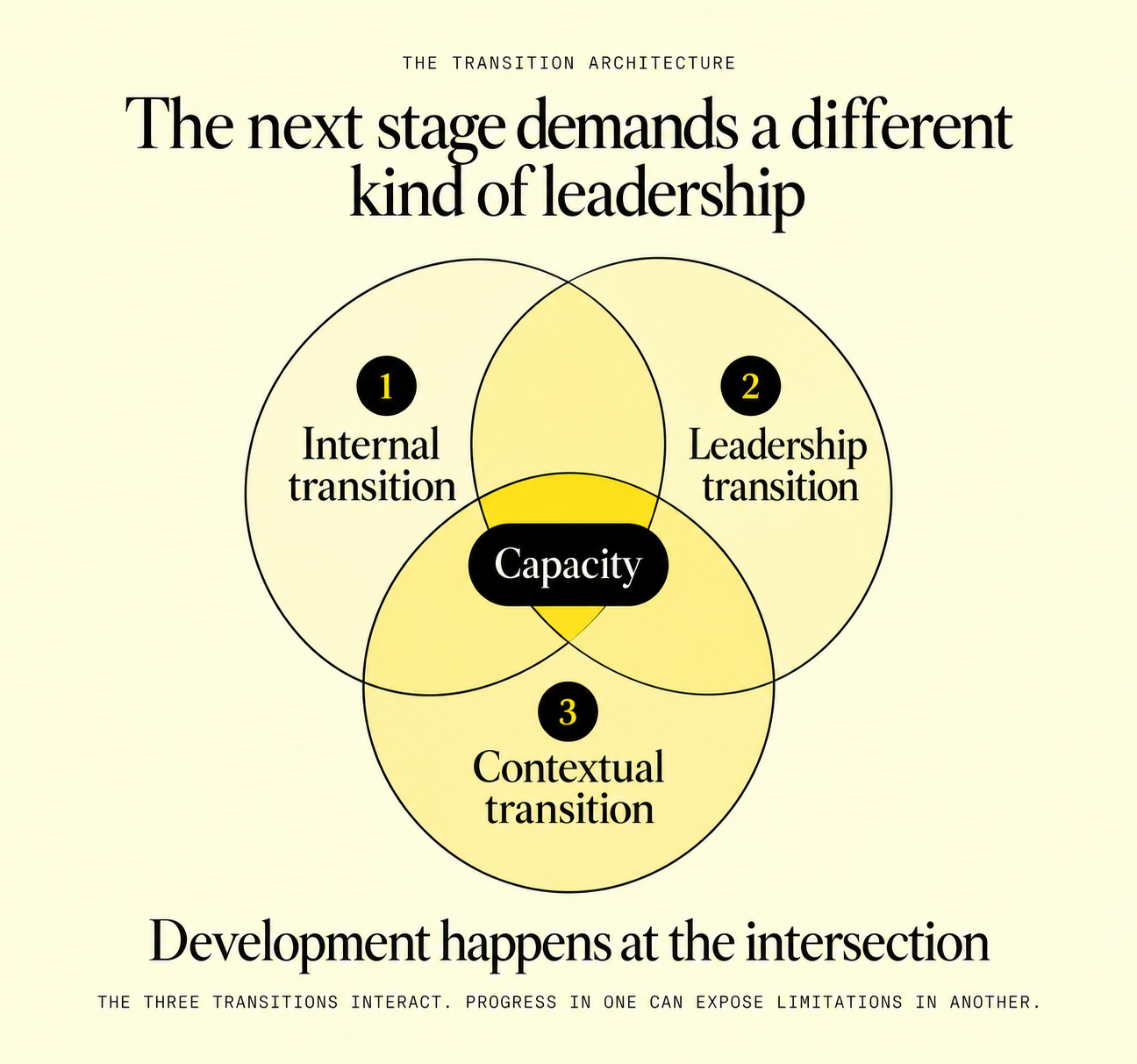
Leadership transitions change how you see yourself, how you lead others and how you respond to the world around you. These shifts rarely happen at the same speed. You may understand the strategic direction yet struggle to relinquish control. We look at all three together.
INTERNAL
The psychological and emotional shift in your identity, confidence, ambition and values. You may understand what needs to change while remaining attached to the role or expertise that made you successful.
LEADERSHIP
The shift from individual contribution to creating results through others. We examine your judgment, delegation, relationships and the practices that give your team direction, clarity and accountability.
CONTEXTUAL
Company growth, investor expectations, organisational complexity, international expansion and AI can change what effective leadership requires. We examine which assumptions behind your previous success still hold.
02 / FIND THE CONSTRAINT
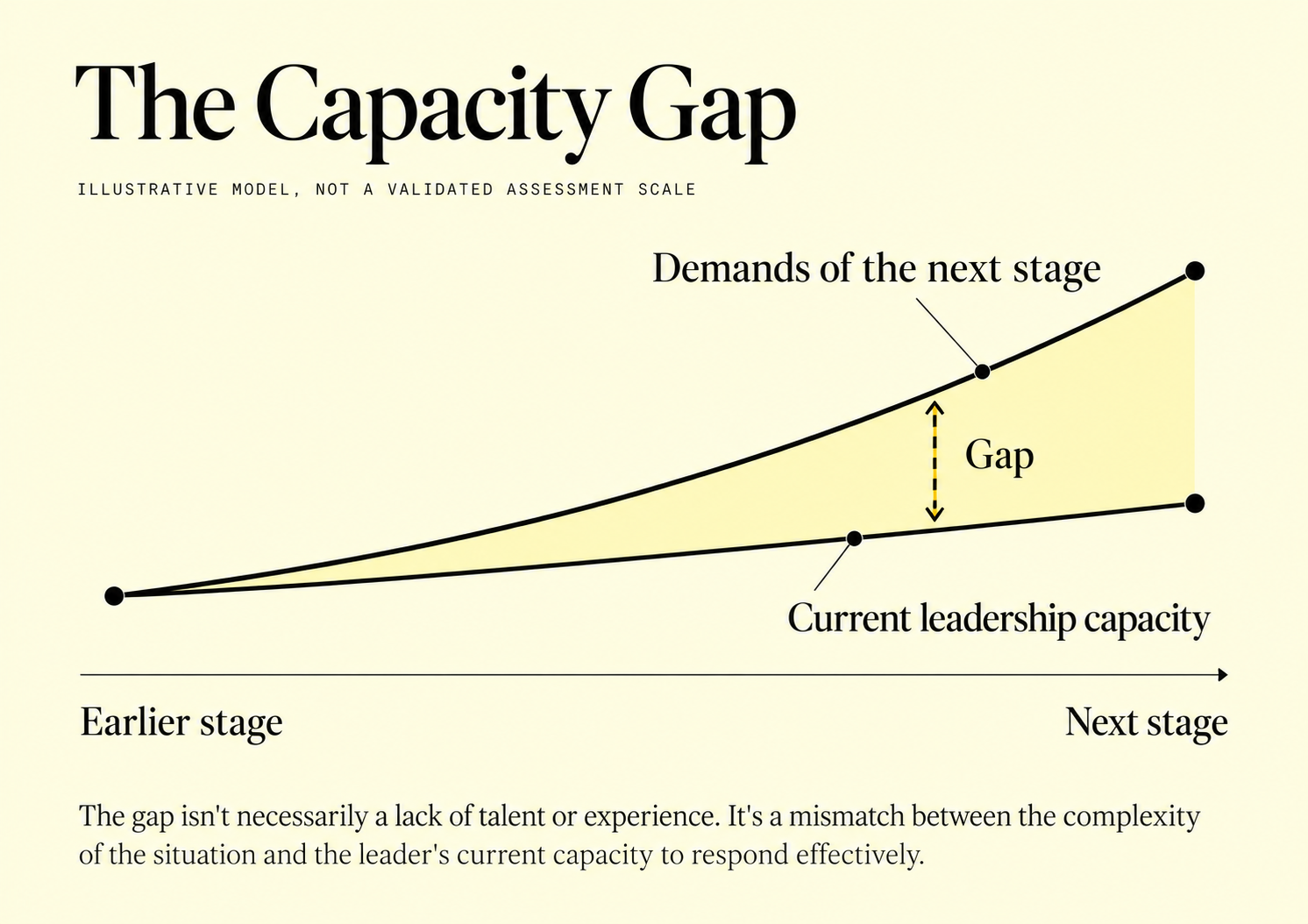
The Capacity Gap is the distance between what your next stage demands and your current capacity to respond effectively. It may show up in identity, judgment, relationships, leadership practice or adaptability. It does not automatically mean you lack talent or experience.
Sometimes the apparent gap comes from unrealistic expectations, unclear responsibilities or the way the organisation is designed. Coaching begins by distinguishing those constraints from the capacity you need to develop.
03 / UNDERSTAND THE FRICTION
Transition Tension is the pull between familiar ways of succeeding and the different demands of your next stage.
WHAT MADE ME SUCCESSFUL
TRANSITION TENSION
The discomfort between the two.
WHAT THE NEXT STAGE REQUIRES
You can understand the need to change before you feel ready to lead differently.
FOUNDERS IN TRANSITION
“The business has changed. My role needs to change too.”
Growth, a new team or a change of direction asks you to rethink how you lead.
→ Clarify your role and build a way of leading that fits.
EXECUTIVES IN TRANSITION
“What got me here won’t be enough for what comes next.”
A new role, greater responsibility or a changing organisation calls for a different approach.
→ Find your footing and lead with clearer judgment.
LEADERS AT A CAREER CROSSROADS
“I’ve achieved a lot. Is this still what I want?”
You may be leaving a role, changing career or exploring a different direction—without a clear answer yet.
→ Work out what matters now and take practical steps forward.
HOW WE WORK WITH IT
We explore what the familiar approach gives you, what makes it hard to relinquish and what the new situation requires. Then we test a practical shift in a real leadership situation and reflect on what happens.
These tensions are often a natural part of meaningful transition. Coaching works with the beliefs and identity behind the behaviour.
03 / UNDERSTAND THE FRICTION
WHAT MADE ME SUCCESSFUL
TRANSITION TENSION
Transition Tension is the conflict between your established ways of succeeding and what the next stage requires. A founder may know they need to empower their team but feel uncomfortable surrendering control. We explore what makes that shift difficult.
WHAT THE NEXT STAGE REQUIRES
04 / THE TRANSITION CYCLE
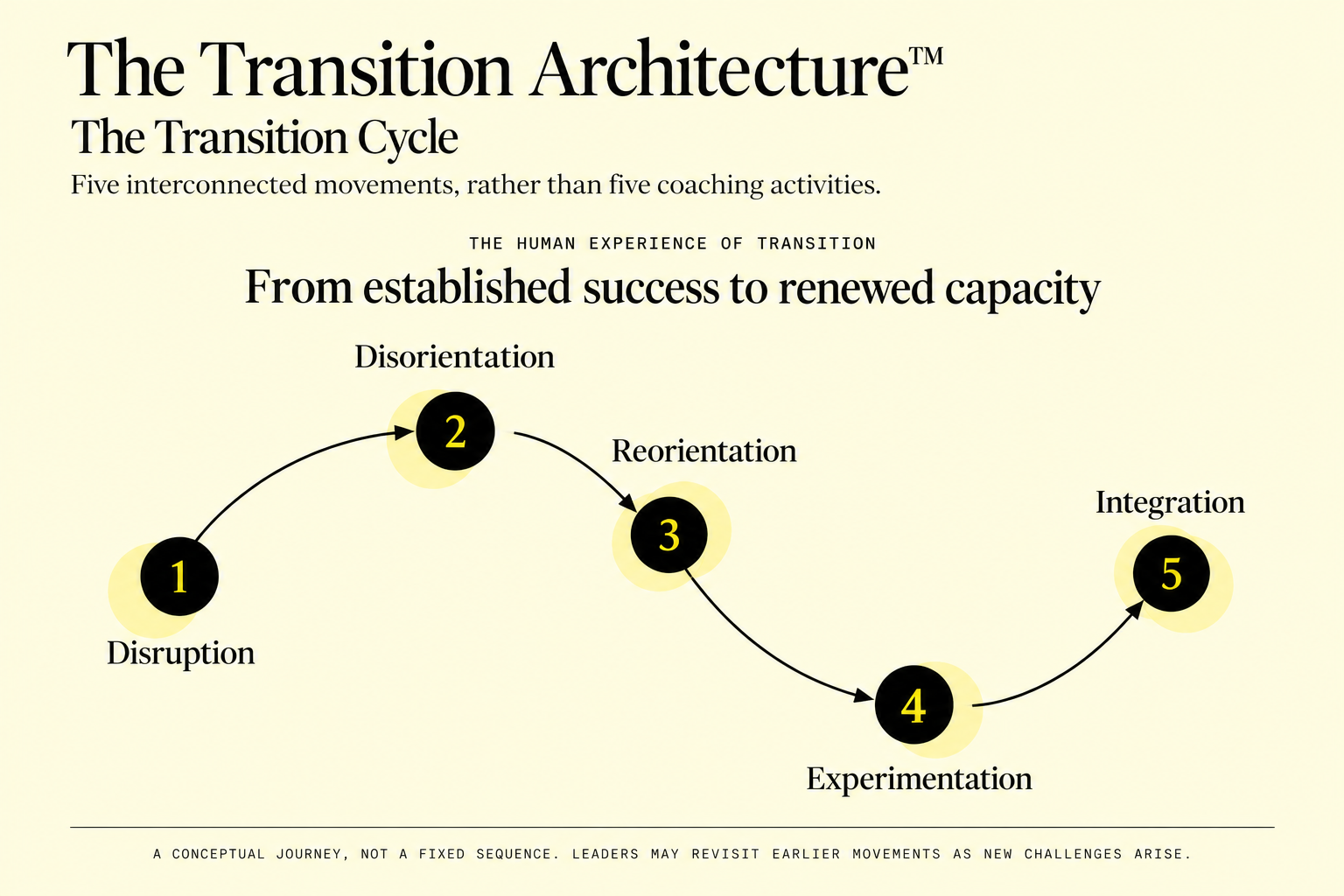
The cycle describes the human experience of moving towards a new way of leading. It is not a prescribed curriculum. You may be testing new behaviours while still uncertain about your identity; a new challenge can reopen an earlier tension.
01
A shift in role, scale or expectations challenges your familiar approach. We clarify what has changed and what it now asks of you.
02
You know change is needed but do not yet know how to lead differently. We explore uncertainty, underlying beliefs and what feels difficult to relinquish.
03
You begin redefining your role and contribution. We broaden your perspective and find ways to use your existing strengths differently.
04
You test new approaches to decisions, delegation, communication or stakeholder relationships. We examine what happens and adapt through experience.
05
New behaviours and perspectives become more natural. We embed the practices that support independent judgment, confidence and a sustainable working rhythm.
THE WORK, IN PRACTICE
IN THE ROOM
Bring a decision, a recurring frustration or a role you are growing into. We step back from the symptoms, identify the transition behind the challenge and examine the assumptions and trade-offs shaping your choices.
BETWEEN SESSIONS
Turn insight into a practical experiment: a decision you delegate, a conversation you approach differently or a boundary you hold. The work connects reflection with decisions and actions in your working life.
WHEN WE RETURN
Review the evidence, explore the tension and adjust. We also look at where your time and energy go, making space for the work only you can do and a pace you can sustain.
FOR EXAMPLE
We examine what being indispensable means to you, how authority is shared and whether your team has the clarity to own it. Then we test one meaningful shift in ownership.
THE COMPLETE ARCHITECTURE
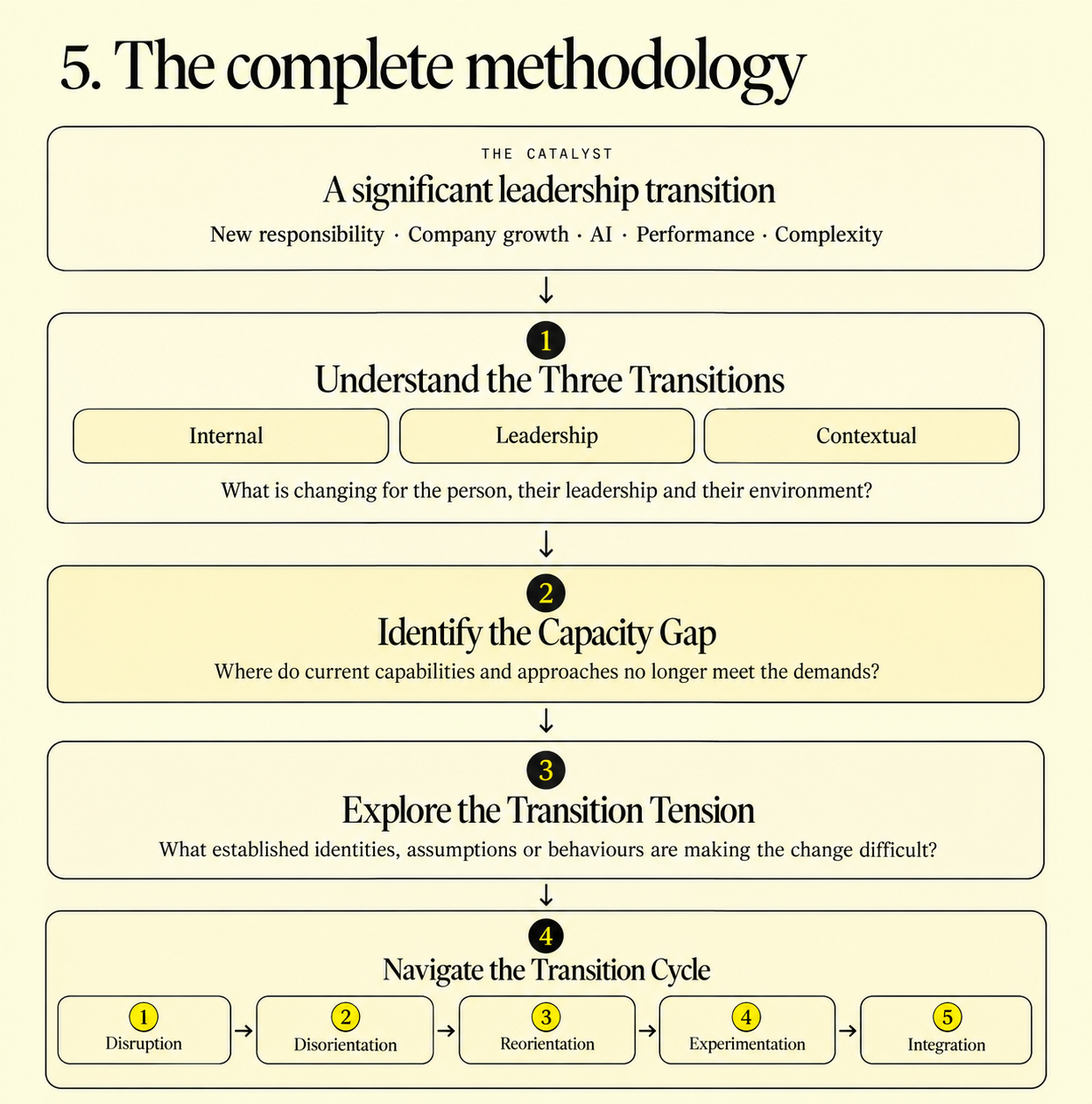
A change in responsibility, company growth, AI or a performance challenge provides the starting point. We understand the three transitions, identify the Capacity Gap, explore the Transition Tension and use the cycle to guide the work. The aim is clearer judgment and a practical path into what comes next.
GO DEEPER
The complete methodology, including its foundations, examples and central questions.
An executive coaching methodology for leaders navigating growth, complexity and change.
The leader who got you here may need to become a different leader to take you further.
Leadership transitions are not simply about acquiring new skills or taking on greater responsibility. They require changes in how people see themselves, how they lead others, and how they respond to the world around them.
A founder becoming a scale-up CEO, a functional leader becoming an executive, or an experienced leader adapting to the AI era may all face different challenges. But the underlying experience is similar.
The demands of the next stage have changed. Their established ways of thinking, leading and defining success may no longer be sufficient.
The Transition Architecture is designed to help leaders understand that change, navigate the personal and professional tensions it creates, and develop the capacity to succeed in what comes next.
Every significant leadership transition involves three interconnected dimensions.
The psychological and emotional changes that accompany greater responsibility.
This includes identity, confidence, self-awareness, personal values, emotional regulation, ambition, and beliefs about what makes someone successful.
A leader may intellectually understand what needs to change while still being attached to the identity that made them successful.
The shift in how someone exercises judgment, influences others, builds teams and creates performance.
As responsibility increases, success becomes less dependent on individual contribution and more dependent on the ability to develop people, make decisions, create clarity and lead through others.
This requires different behaviours, relationships and operating practices.
The external changes reshaping what effective leadership looks like.
These may include company growth, investor expectations, organisational complexity, competitive pressures, international expansion and the impact of AI.
Leaders must adapt not only to a new role, but often to a world in which the assumptions behind their previous success are changing.
The key insight is that these transitions rarely happen at the same speed.
A CEO may understand the strategic direction but struggle to relinquish control. An executive may have developed greater confidence but still lack the judgment required for board-level decisions. A highly experienced leader may be effective in a traditional operating model but uncertain about leading AI-enabled teams.
This creates the central challenge the methodology addresses.
The Capacity Gap is the difference between what a leader's next stage demands and their current capacity to respond effectively.
Illustrative conceptual model, not a validated measurement instrument.
Importantly, a Capacity Gap does not automatically mean the leader lacks talent, experience or capability.
It may reflect a mismatch between the complexity of their circumstances and the ways they have learned to operate.
The gap may sit in several areas:
Sometimes the constraint is not within the individual. Unrealistic expectations, unclear responsibilities or a poorly designed organisation can create the apparent gap.
The coaching begins by distinguishing between these possibilities.
Identifying a Capacity Gap explains what needs to change. It does not necessarily explain why change is difficult.
This is where the Transition Tension becomes important.
The Transition Tension is the conflict between the leader's established ways of succeeding and the different demands of their next stage.
WHAT MADE ME SUCCESSFUL
My established identity
Expertise, control, personal contribution, familiar behaviours and sources of confidence.
WHAT THE NEXT STAGE REQUIRES
My emerging identity
New judgment, delegation, different relationships, uncertainty and new sources of value.
The Transition Tension
The discomfort of moving between established and emerging ways of leading.
A founder may know they need to empower their team but feel uncomfortable surrendering control.
A functional leader may understand the need to become more strategic but continue returning to execution because it is where they feel most competent.
An experienced executive may recognise the significance of AI while privately questioning how their expertise will remain valuable.
These tensions are not necessarily weaknesses. They are often a natural part of meaningful transition.
The coaching helps leaders recognise and work through them rather than simply trying to change surface-level behaviours.
The Transition Cycle describes the human experience of moving from an established way of leading towards a new one.
It draws on established thinking about psychological transitions, particularly William Bridges' distinction between external change and internal transition, while adapting that thinking to executive leadership.
THE TRANSITION CYCLE
A recurring journey, not a rigid sequence. Leaders may move back and forth between movements.
A shift in role, scale, expectations or environment challenges the assumptions behind previous success.
The coaching helps the leader make sense of the change, understand what is being asked of them and recognise which established approaches may no longer be sufficient.
Central question: What has changed, and what does it mean for me?
The leader may understand that change is necessary without yet knowing how to operate differently.
Familiar sources of confidence and competence are challenged. Uncertainty, resistance or self-doubt may emerge.
Coaching creates space to explore these experiences, understand underlying beliefs and work through what the leader may need to relinquish.
Central question: What am I finding difficult to let go of, and why?
The leader begins redefining their role, contribution and relationship with others.
This involves examining assumptions, broadening perspective and developing a more mature understanding of what effective leadership requires.
The objective is not to abandon their previous strengths but to use them differently.
Central question: Who do I need to become, and what kind of leader do I want to be?
New thinking is tested in practice.
Leaders try different approaches to decision-making, delegation, communication, team development and managing stakeholders.
Some experiments succeed. Others reveal new assumptions, limitations or tensions.
Coaching helps them reflect, adapt and build confidence through experience.
Central question: What happens when I lead differently?
Different behaviours and perspectives become increasingly natural.
The leader develops a stronger sense of identity, more independent judgment and greater confidence navigating complexity.
Rather than consciously trying to perform a new role, they begin to feel established within it.
Central question: What has changed in how I think, act and understand myself?
These movements are not a prescribed curriculum. A leader may be experimenting with new behaviours while still experiencing uncertainty about their identity. A new challenge may also reopen an earlier tension.
The cycle provides a way of understanding the experience and adapting the coaching accordingly.
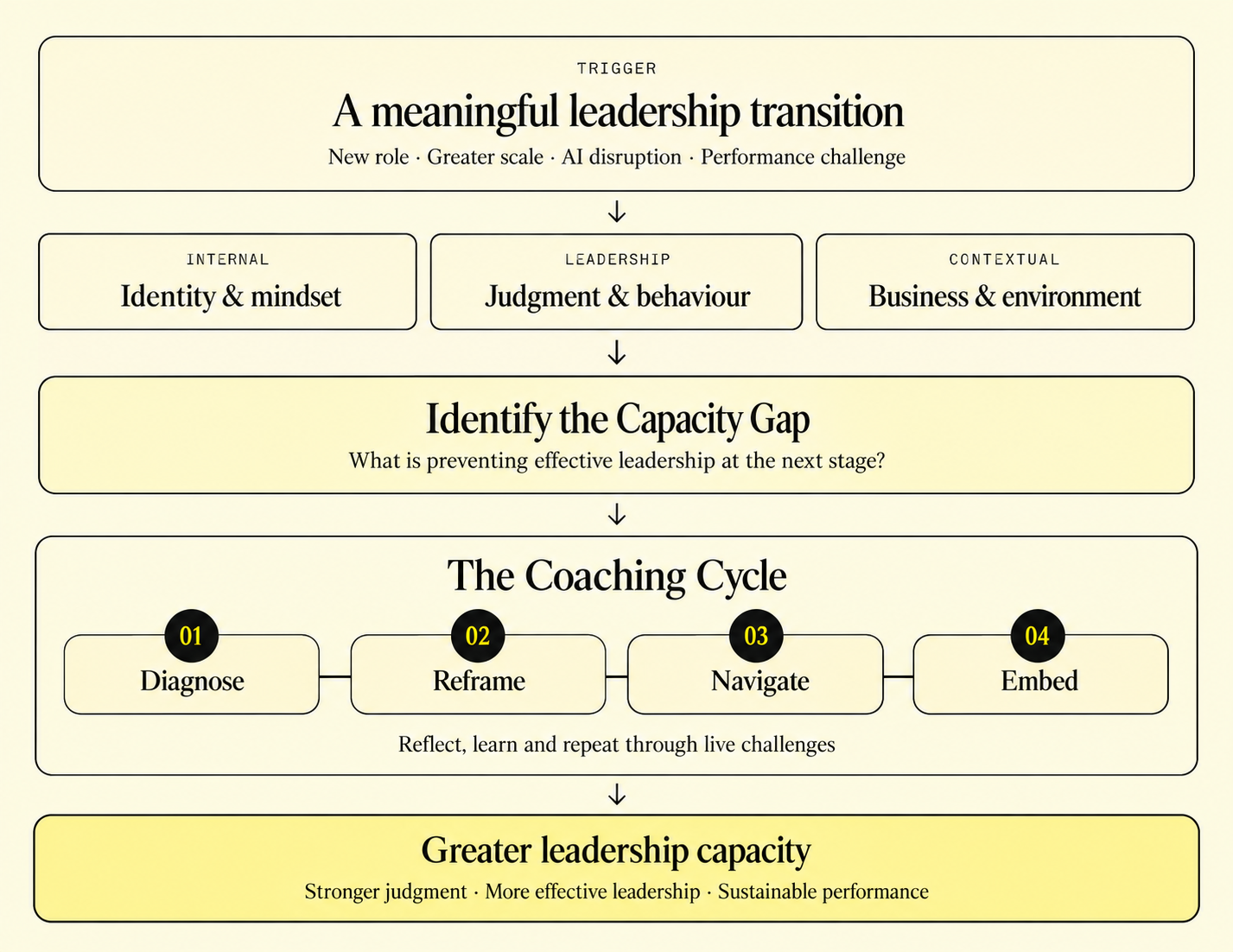
A new role, company growth, a career pivot or a change in your environment can make familiar approaches less effective. We work through four connected questions.
Look at the three simultaneous transitions: internal—your identity and confidence; leadership—how you lead and create value; and contextual—the demands of your business, career and environment.
Where does your current capacity fall short of what the next stage requires? Name the capabilities, perspectives or approaches you need to develop.
What feels difficult to let go of? Examine the identities, assumptions and habits that helped you succeed but may now be holding you back.
Move through five interconnected movements: disruption, disorientation, reorientation, experimentation and integration. These describe the experience of transition, rather than a fixed sequence of coaching sessions. You may revisit them as new challenges arise.
Throughout, we connect reflection with practical decisions and experiments—building capacity for what comes next.
THE CATALYST
A significant leadership transition
New responsibility · Company growth · AI · Performance · Complexity
1. Understand the Three Transitions
Internal
Leadership
Contextual
What is changing for the person, their leadership and their environment?
2. Identify the Capacity Gap
Where do current capabilities and approaches no longer meet the demands?
3. Explore the Transition Tension
What established identities, assumptions or behaviours are making the change difficult?
4. Navigate the Transition Cycle
1
Disruption
2
Disorientation
3
Reorientation
4
Experimentation
5
Integration
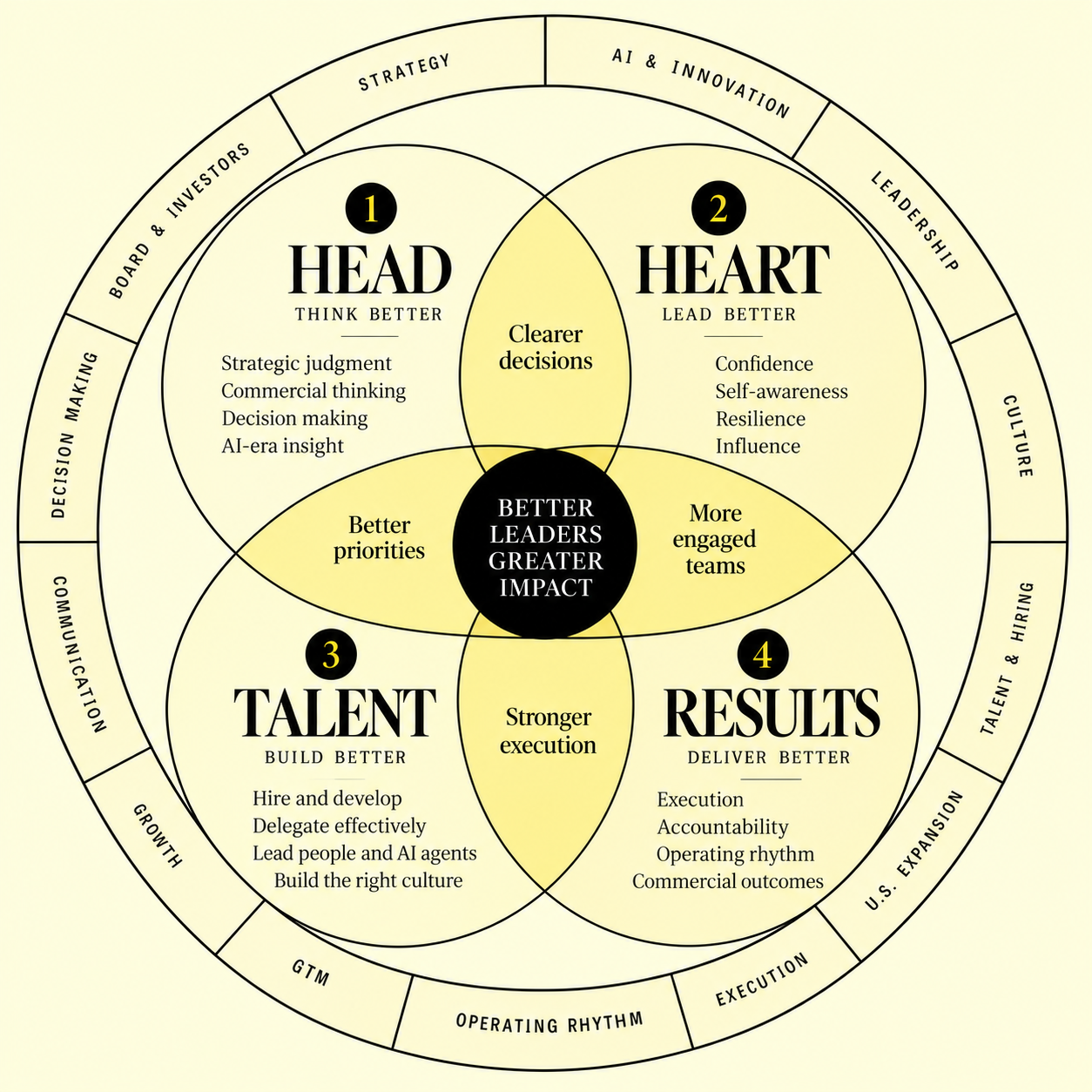
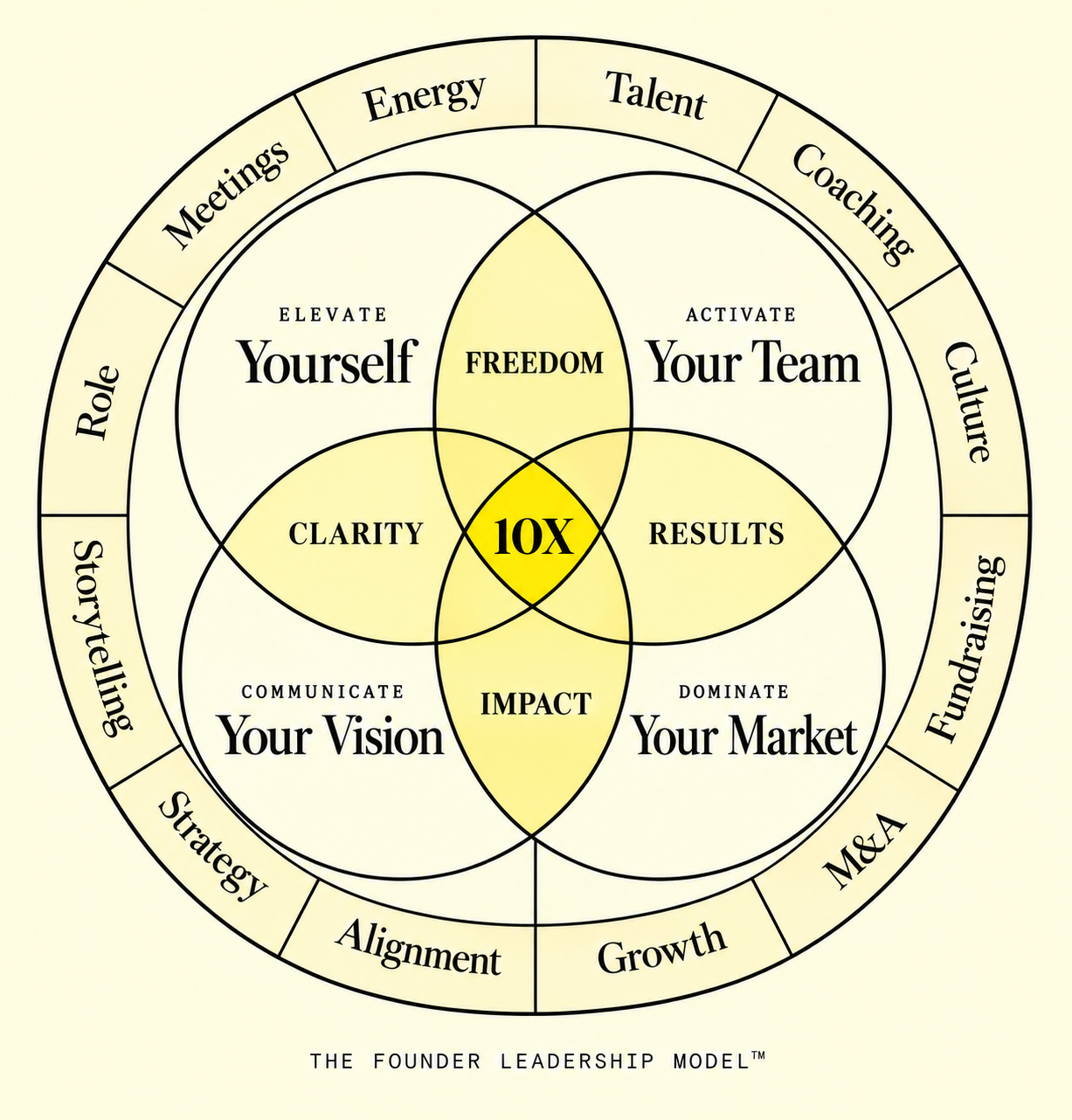
This earlier four-activity diagram is retained for context. The current methodology uses the five-movement Transition Cycle described above.
FROM THOSE I HAVE WORKED WITH

“His frameworks, approach and importantly style is engaging and efficient.”
Chris Barbin · Founder & former CEO at Appirio
From a recommendation on Edwin’s advisory work in the Tercera Advisor Network.
Founders, CEOs, executives and aspiring leaders navigating a change in responsibility, company scale or direction. You might want to lead more effectively within your company, prepare for a bigger role or explore a different next chapter.
A change in role, strategic priorities, company growth, team leadership, difficult decisions, AI-enabled leadership, personal blockers or a career transition. We can also explore where you want to be in two or three years. We begin with the question that matters most now.
Coaching focuses on your thinking, judgment and development as a leader. Advisory brings direct input on the business. My approach blends coaching, mentoring and practical perspective; I make it clear when I am contributing experience or advice, so you can decide what is useful.
After an initial conversation, we agree the focus, format and session cadence. Sessions connect reflection with the decisions and actions in your working life, with room between them to experiment. We review what you learn and adapt the work as your situation changes.
We discuss scope and pricing on a discovery call, once we understand what you need and what working together would involve.
Request a discovery call. We will talk about what you are navigating, what you want from coaching and whether working together makes sense. You do not need a fully formed brief.
PRACTICAL DETAILS
Founders, CEOs, executives and aspiring leaders navigating a change in responsibility, company scale or direction. You might want to lead more effectively within your company, prepare for a bigger role or explore a different next chapter.
A change in role, strategic priorities, company growth, team leadership, difficult decisions, AI-enabled leadership, personal blockers or a career transition. We can also explore where you want to be in two or three years. We begin with the question that matters most now.
Coaching focuses on your thinking, judgment and development as a leader. Advisory brings direct input on the business. My approach blends coaching, mentoring and practical perspective; I make it clear when I am contributing experience or advice, so you can decide what is useful.
After an initial conversation, we agree the focus, format and session cadence. Sessions connect reflection with the decisions and actions in your working life, with room between them to experiment. We review what you learn and adapt the work as your situation changes.
We discuss scope and pricing on a discovery call, once we understand what you need and what working together would involve.
Request a discovery call. We will talk about what you are navigating, what you want from coaching and whether working together makes sense. You do not need a fully formed brief.
COACHING WITH EDWIN ABL
Start with a conversation about what is changing and where you feel the friction.
Request a discovery call ↗We agree the focus, cadence and investment after an initial conversation.